What to Actually Eat in Osaka: A Local's Guide to Takoyaki, Okonomiyaki, Kushikatsu & Nikusui
Written by an Osaka restaurant owner. How to spot tourist traps, where locals actually eat takoyaki and okonomiyaki, and why every Osaka home has a takoyaki maker.
Osaka calls itself the nation’s kitchen. Here’s how to eat like you live here — including the tourist traps to skip, written by someone who’s on the other side of the counter every day.

The 30-second version:
- Learn to spot tourist restaurants first (hint: if the sign is in English, it’s not for locals)
- Takoyaki: skip the famous queues, eat where we eat — and yes, every Osaka household really does own a takoyaki maker
- Okonomiyaki: eat it with chopsticks, don’t touch it mid-cook without asking, and order rice with it if you want to eat like a local
- Kushikatsu: it’s cheap street food — any shop is fine, don’t queue for it
- Nikusui: the hangover dish invented by a comedian, and the two words that make you sound like a regular
First: how to tell a tourist restaurant from a local one
Nobody teaches you this, so we will. Three signs you’re looking at a restaurant built for tourists, not locals:
1. The sign is in English. Here’s the logic: Japanese people live their entire lives in Japanese. A restaurant that puts English on its main sign is telling you exactly who its customers are — and it’s not the neighborhood. That doesn’t automatically mean bad food, but it means tourist food at tourist prices. The best places in Osaka never needed to translate anything.
2. The sign is huge and flashy. A giant 3D crab, a mechanical octopus, a billboard you can see from space — that’s marketing budget. Money spent on the sign is money not spent on what’s on your plate. It usually means a chain, or a place that catches you with its looks. The rule of thumb locals live by: the better the restaurant, the more modest the sign.
3. The sign has no hiragana or katakana — kanji only. This one’s for the real heads, because most Western visitors can’t tell Japanese and Chinese writing apart. Japanese writing mixes three scripts — kanji (the complex characters) plus hiragana and katakana (the simpler, rounder ones). If a sign is entirely complex characters with none of the simple rounded ones, there’s a very good chance it’s actually Chinese — often a Chinese-run restaurant serving Chinese customers. Nothing wrong with that, but if you walked in thinking you’d found an “authentic local Japanese place,” you’ve just ordered mapo tofu by accident. Quick check: see any round, simple characters like の, し, や? That’s Japanese. All dense complex characters? Probably Chinese.
And the flip side — signs you’ve found a good local place:
- It’s clean. Old is fine — great, even. But a well-kept entrance, a cared-for noren curtain, a wiped-down counter: that’s a place that takes pride in details, and it shows up in the food.
- There’s no menu displayed outside. Tourist places put photo menus, plastic food, and prices on the street to pull you in. Local places don’t need to — their customers already know. The place that looks “scary” because you can’t see what’s inside? That’s often exactly where you want to be.
- It’s not on the ground floor. A restaurant on the 2nd floor or in a basement can’t catch walk-in traffic. If it survives up there anyway, it survives on food and reputation alone. Tourists never climb those stairs. That’s the point.
Takoyaki: the octopus balls that live in every Osaka home
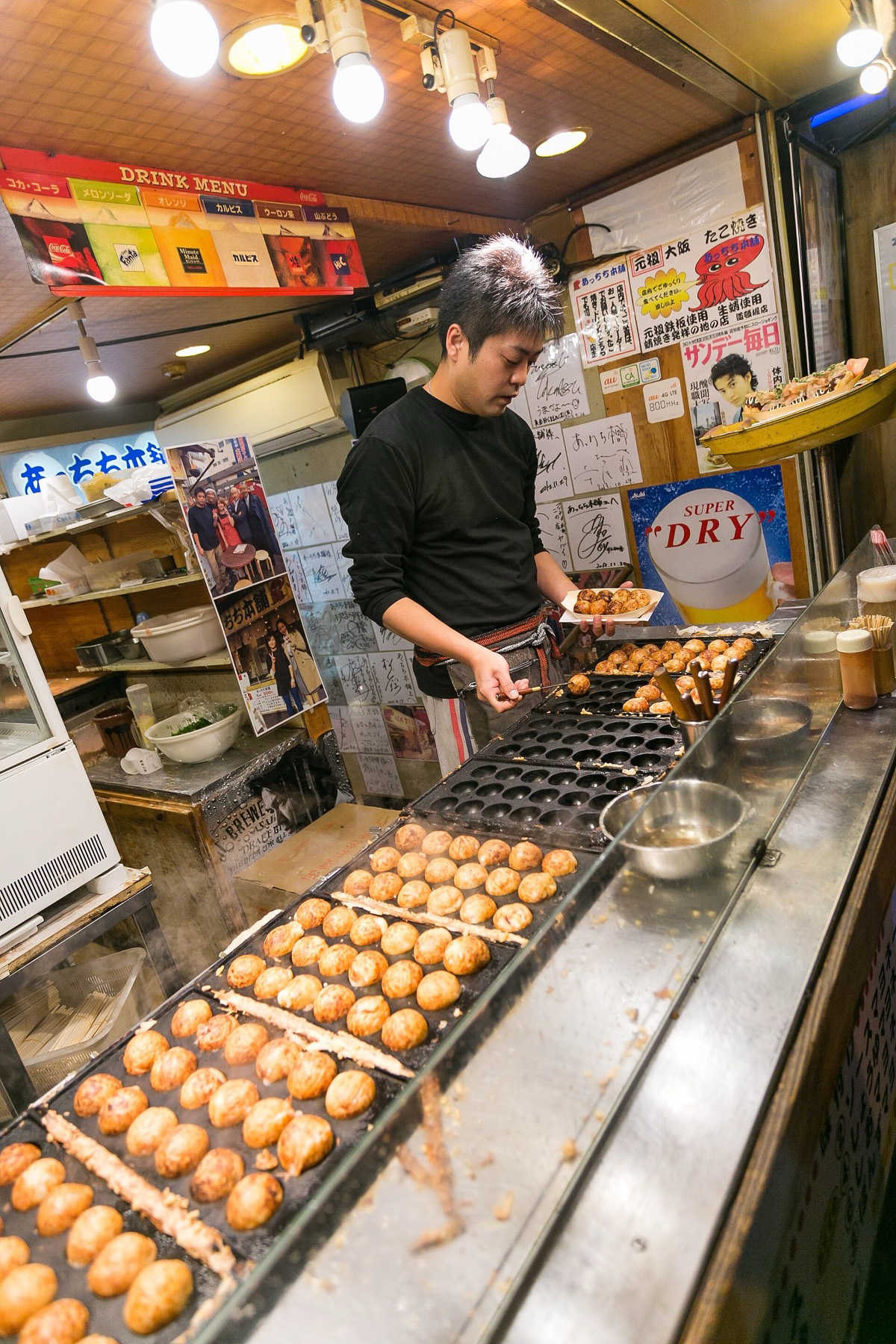
The one fact that explains everything: ask anyone from Osaka — literally anyone — “do you have a takoyaki maker at home?” The answer is yes. Almost every household owns one. Try it as a party trick; you’ll get a laugh and an enthusiastic “of course!” Takoyaki isn’t a tourist attraction here. It’s a home appliance. Friends come over, you fire up the takoyaki plate, everyone burns their mouth together. That’s the culture you’re stepping into.
Which is exactly why the famous tourist-queue takoyaki stands feel off to locals. Takoyaki is an everyday food — queueing 40 minutes for it is like queueing for toast.
Where locals actually go (four shops, four moods — full details, hours and what to order in our takoyaki guide):
- Takotako King (multiple locations) — When you want takoyaki with drinks and small dishes. This is the takoyaki-izakaya style: sit down, order beer, graze. (An unordered little dish may arrive with your drink — that’s otoshi, and here’s how it works.) Takoyaki as a proper night out, not a street snack.
- Wanaka (Sennichimae main shop near Namba Grand Kagetsu, 12 locations as of October 2026) — For variety and that perfect kari-fuwa (crisp outside, fluffy-molten inside) texture. Their kettle-cooked salt version is the move — more on salt below.
- Kougaryu — The classic, orthodox takoyaki. When you want the standard done properly.
- Umaiya (Tenma / Tenjinbashi area) — The deep cut. A Showa-era institution in the Tenjinbashisuji shopping-street area, running since 1953, Michelin Bib Gourmand — and it still looks like your grandparents’ kitchen. The batter is so dashi-rich you don’t even need sauce. This is as local as takoyaki gets.
How to eat it without embarrassing yourself (or burning yourself):
- It is molten inside. You do not have to eat it in one bite. Nobody will judge you for biting it in half and letting it steam. Locals do it too. The tourists who pop a whole one and then panic-breathe through their teeth? Every stand watches that show daily.
- The default topping set: sauce, mayo, aonori (green seaweed powder), and katsuobushi — the dancing bonito flakes. And yes, they move on their own. It’s the heat, not bugs. You’re fine.
- The connoisseur move: salt. Sauce is the default, but insiders order takoyaki with just salt — it lets you actually taste the batter. Ponzu (citrus-soy) is also quietly excellent.
- The topping Westerners consistently love: green onion (negi). We see it every day — if you like fresh, sharp flavors on rich food, order the negi-topped version and thank us later.
Okonomiyaki: the savory pancake with actual rules
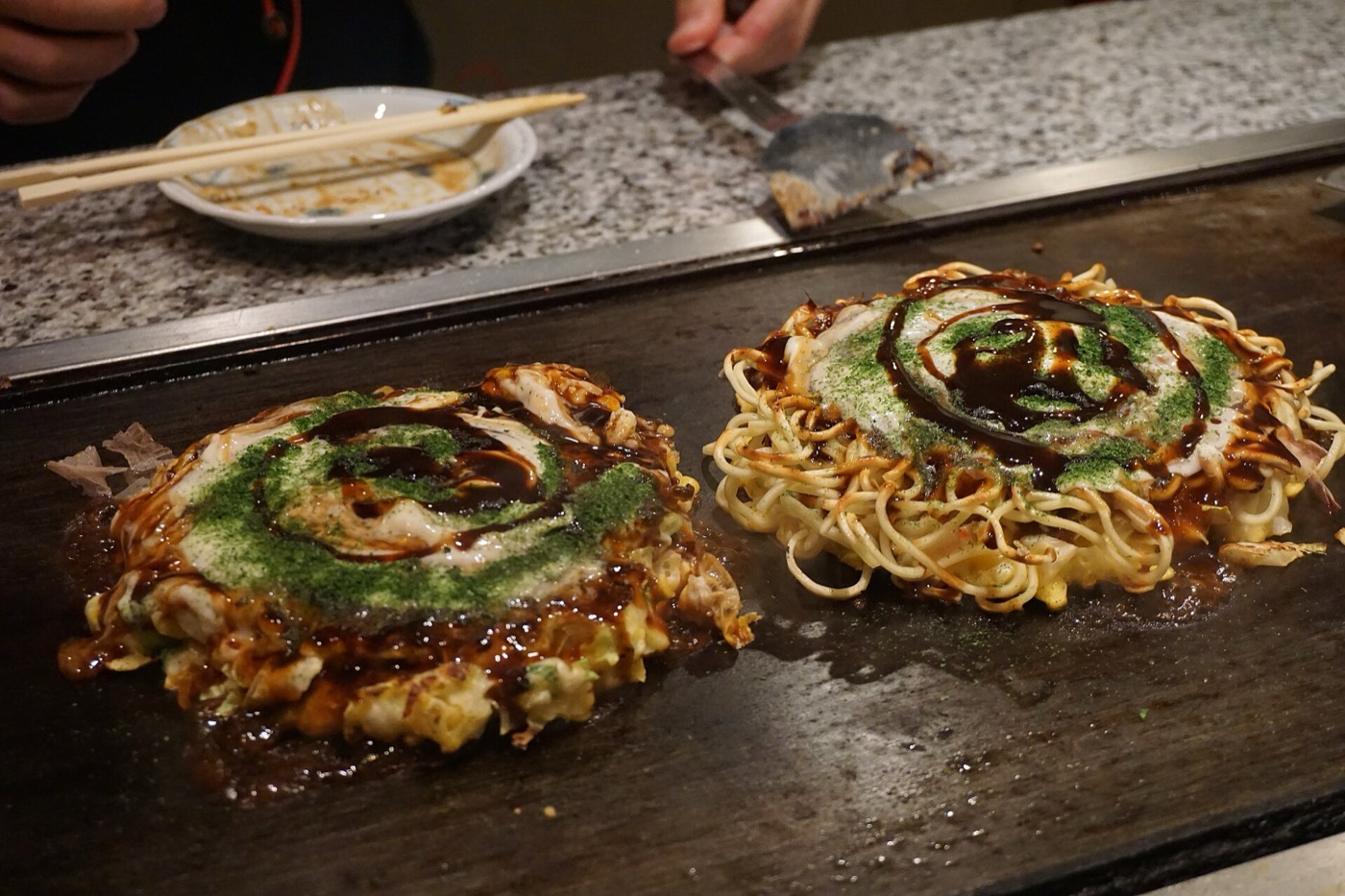
Okonomiyaki is also made at home a lot — but unlike takoyaki, this is one where the restaurants genuinely earn their keep. Some are excellent.

Where to go:
- Chibo — The dependable classic, multiple locations. And if you want to see okonomiyaki go black-tie, their high-end line President Chibo serves it in a setting closer to a steakhouse than a street stall. Yes, luxury okonomiyaki exists. Only in Osaka.
- Ajikuraya (Uehommachi) — Go here if you love yakisoba too; doing both in one sitting is the correct decision.
- Omoni (Tsuruhashi main shop, also in Grand Front Umeda) — A Tsuruhashi legend hidden in a residential street. Order the tetchan (beef intestine) kimchi — dip it in mayonnaise and, in the words of our editor, “you will forget every problem you have.” If offal isn’t your thing, their standard omoni-yaki is a top-tier okonomiyaki in its own right.
The rules nobody tells you:
- Eat it with chopsticks. You’ll read online that “real Osakans eat straight off the griddle with the metal spatula (kote).” We have never seen a single friend do this. The kote is enormous — as our editor puts it, “it’s way too big to be a spoon.” And the pancake is lava-hot off the griddle. Monjayaki in Tokyo uses tiny spatulas; that’s a different dish. In Osaka: chopsticks. Case closed. (Worried about your chopstick manners in general? Here’s what actually matters.)
- These days, the staff usually cooks it for you. Some places still let you cook your own at the table griddle, but most will handle it. Important: do not touch it mid-cook without asking. Flipping someone’s carefully timed okonomiyaki is a genuine way to get scolded by the chef. If you want to participate, ask first — most places are happy to let you flip under supervision.
- The sauce and mayo finish is usually done for you too. Your job is to wait, then eat.
- And the rice thing. Kansai people eat okonomiyaki with a bowl of white rice. People from Tokyo find this bizarre — carbs on carbs — and honestly, so does everyone else. It is completely normal here. In fact, here’s your authenticity test: if someone claims to be an Osaka local and doesn’t order rice with their okonomiyaki… they might be an impostor. Use this knowledge wisely.
Kushikatsu: relax, it’s just fried stuff on sticks
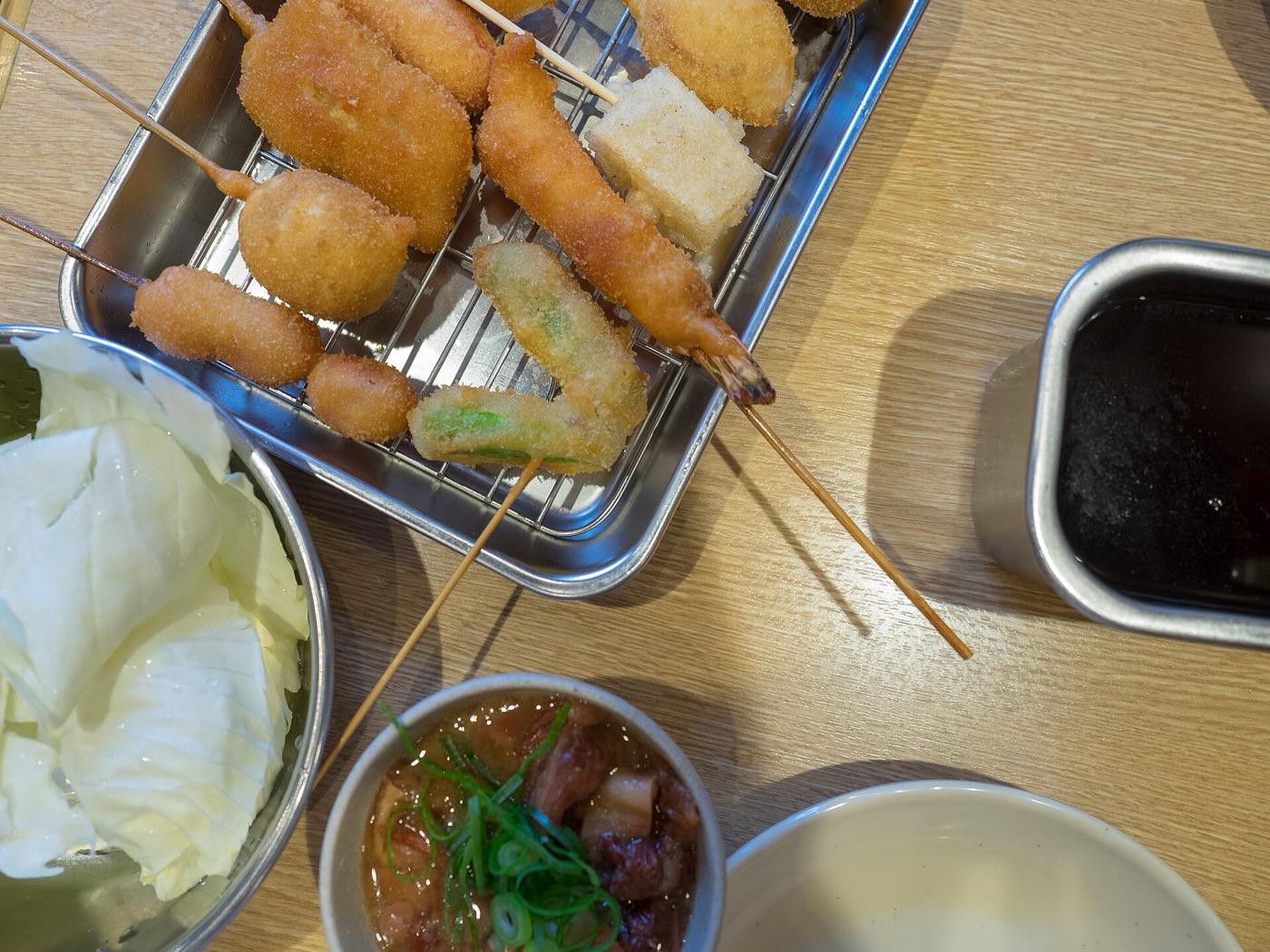
Time for some honesty that no other guide will give you: kushikatsu is B-grade street food, and the difference between shops is small. The famous tourist spots in Dotonbori and Shinsekai? Locals mostly don’t go. Not because it’s bad — it’s fine — but it’s just fine, at slightly tourist prices, with a queue attached. There is no transcendent kushikatsu experience waiting at the end of a 30-minute line. Pick whatever shop is in front of you, order a beer, enjoy. That’s the whole game.

(One exception: if you want to see kushikatsu in a tuxedo, Bon in Kitashinchi is the luxury version — a Michelin-starred kushikatsu house that’s expanded from Osaka to Ginza and Paris. Completely different genre, completely different price tag.)
The famous rule: no double-dipping. At shops with a shared sauce container on the table or counter, you dip your skewer once, before biting. Why? Because that same sauce serves the next customer. Bite, then re-dip, and your mouth just touched everyone’s sauce.
Find that gross? Consider: it’s the same logic as cheese fondue — everyone’s bread, one communal pot, nobody dies. Or, as our editor explains Japanese bath culture: families share the same bathwater (you wash before soaking, so the water stays clean), and nobody re-fills the tub per person. “Except for the dad nobody likes,” he adds. “Wait, what were we talking about?”
The workaround if you need more sauce: use the free cabbage as a spoon to scoop sauce onto your skewer. That’s what it’s there for. If the shop gives you your own individual sauce dish, dip as many times as you want — the rule only exists for shared containers.
Nikusui: the hangover masterpiece invented by a comedian
Here’s a dish with an origin story worthy of Osaka, the city of comedy: one morning, a hungover Yoshimoto comedy performer named Hanaki Kyo stumbled into Chitose, a little udon shop near the Namba Grand Kagetsu comedy theater, and ordered “niku udon, hold the udon” — beef udon soup, without the noodles. The shop obliged. Word spread. Today nikusui (literally “meat soup”) is the shop’s signature dish and an Osaka institution: rich dashi, tender simmered beef, green onion, no noodles. The perfect food for a stomach that regrets last night.
How to order like a regular:
- Say “gyoku ari” (玉あり) — “with egg” — and they’ll add one. Two words, instant regular status.
- Curious detail nobody can explain: order nikusui and the egg comes poached (soft, floating in the broth). Order niku udon and it’s a raw egg cracked straight in. Same shop, same egg, different physics. Why? Nobody knows. That’s just how it is.
- If you can’t handle raw egg — and many visitors can’t — confirm before you order. The magic words: “Nama tamago? Yude tamago?” (Raw egg? Boiled egg?). Point at the menu, say those words with a questioning face, and you’ll be understood.
- The standard local order at Chitose: nikusui + kodama (small tamago-kake-gohan — raw egg over rice with their special soy sauce). Yes, that’s egg in your soup and egg on your rice. When in Osaka.
One last thing about food rules
A fun fact to close on: Japanese people eat gyoza with rice — dumplings as a side dish for more carbs — and Chinese people find this absolutely baffling, since gyoza are the meal in China. Meanwhile Tokyo people mock Osaka’s okonomiyaki-with-rice, Westerners are horrified by slurping, and everyone thinks everyone else’s food habits are weird.
Which is the real lesson of eating in Osaka: there is no universally “correct” way to eat. There’s just what people grew up with. Learn the couple of rules that actually matter (the shared sauce, the mid-cook touching), laugh at the rest, order the rice, ask for the negi topping, and eat like you live here.
Most of these places are in or near Minami — if you’re choosing where to sleep, our Osaka neighborhood and hotel guide covers which base puts you closest to the food.
FAQ
Is the famous kushikatsu in Dotonbori worth queueing for? Honestly? No. Kushikatsu is inexpensive street food and quality barely varies between shops. Locals skip the queues entirely. Walk into any non-famous shop and you’ll eat just as well, cheaper, with no wait.
Where do locals actually eat takoyaki in Osaka? Depends on the mood: Takotako King for takoyaki with drinks, Wanaka (Sennichimae) for variety and texture, Kougaryu for the orthodox classic, and Umaiya in Tenma for the deep-local, 60-year-old-institution experience.
Do you eat okonomiyaki with chopsticks or the spatula? Chopsticks. The giant spatula (kote) is a cooking tool, not cutlery — despite what the internet tells you, locals don’t eat with it.
What is the no-double-dipping rule in kushikatsu? At shops with shared sauce containers, dip your skewer only once, before biting — the sauce is communal. Use the free cabbage to scoop extra sauce if needed. Shops with individual sauce dishes have no such rule.
What is nikusui? Beef udon soup without the noodles — invented at Chitose in Namba when a hungover comedian ordered “niku udon, hold the udon.” Order it with “gyoku ari” for a poached egg.
Is it true every Osaka home has a takoyaki maker? Basically, yes. Ask any Osaka person — it’s the most reliable laugh in the city.
Written by a Kansai-based team that includes an actual Osaka restaurant owner — so this is the view from the other side of the counter. Shop details verified July 2026; hours and locations change, so double-check before you go.