Is Shinsaibashi Worth It? Shinsaibashi-suji vs Midosuji vs Amerikamura, and How to Do It on Foot from Namba
Shinsaibashi is three different places within a block of each other: a covered shopping arcade, a ginkgo-lined department-store boulevard and the vintage-clothing streets of Amerikamura. What each one is like, who it suits, which station exits to use, a mostly covered walk from Namba, and whether to stay there.
“Shinsaibashi” isn’t one place. It’s three streets a block apart that suit completely different people, and most visitors only find one of them.

The 30-second answer:
- Shinsaibashi is worth it if you shop. If you don’t, give it 30 minutes on your way somewhere else, or skip it. The arcade begins at the Dotonbori canal, so you can walk to it from Namba in about 15 minutes, mostly under a roof.
- It has three parts. Shinsaibashi-suji is the covered arcade with the drugstores, souvenir shops and tax-free signs. Midosuji, one block west, is the wide avenue with Daimaru department store, the big-brand stores and the ginkgo trees. Amerikamura (“Amemura”), across Midosuji, is vintage clothing, streetwear and Triangle Park, and it’s best in the late afternoon and evening.
- Station exits: Shinsaibashi Exit 4 for Daimaru and the arcade. For Amerikamura, Exit 7 has been closed since 12 September 2026, so use Exit 8 or Yotsubashi Station Exit 5.
- Go on a weekday morning if you can. The arcade gets about 60,000 people on a weekday and about 120,000 on weekends and holidays.
- As a base, it works for a food-and-shopping first trip, with direct Midosuji Line trains to Umeda and Shin-Osaka. It’s noisy, though, and it isn’t for light sleepers.
What are the three parts of Shinsaibashi, and which one is for you?
Choose by what you want to buy or do, not by the name on the map. All three are a few minutes’ walk apart, but they feel like different cities.
| Shinsaibashi-suji (arcade) | Midosuji (avenue) | Amerikamura (Amemura) | |
|---|---|---|---|
| What it is | Covered pedestrian arcade, about 580 m, about 180 shops | 44 m-wide main road lined with ginkgo trees | Grid of small streets around a tiny triangular plaza |
| Mainly sells | Drugstore cosmetics and medicine, snacks, souvenirs, fast fashion, sneakers | Department store, international luxury and big-brand stores | Vintage (furugi) and streetwear, records, accessories, cheap eats |
| Good for | Rainy days, gift shopping, tax-free hauls, first-timers | Big purchases, window-shopping, autumn and illumination walks | Younger travellers, vintage hunters, people-watching, an evening drink |
| Skip if | You hate crowds or have seen a dozen Japanese drugstores already | You’re not buying anything expensive | You don’t care about clothes and want “traditional Japan” |
| Best time | Weekday mornings | Late November (ginkgo); November–December evenings (lights) | Late afternoon into evening |
Shinsaibashi-suji: is the covered arcade worth it?
Yes, if you have a shopping list, and especially if it’s raining. Osaka’s official tourism site puts the arcade at about 580 m running north–south, with around 180 shops. It traces its trade back to the Edo period, when it was booksellers and kimono-fabric shops.
Today most shops fall into a few groups:
- Drugstores, many of them. Japanese skincare, sunscreen, cold medicine, the snack aisle. Prices vary between chains, so if you’re buying a lot, compare two shops before you commit.
- Souvenirs and character goods. Plenty of it, much of it the same stock you’ll see in Dotonbori and at the airport.
- Fashion chains and sneaker shops. Japanese and global brands, the kind you’ll find in any big Japanese city.
- A few long-running local shops, scattered between the chains.
The tax-free part. Plenty of shops show “Tax Free” signs. Know this before you spend: from 1 November 2026 Japan switches to a pay-now, refund-later system. You’ll pay the tax at the till and get it back only after a customs check at the airport, before you check in your bags. If your trip crosses that date, read how the new refund works before you shop, especially if you’re buying snacks and cosmetics you might open before you fly.
Hours: they vary shop by shop. Expect most shops to open from mid-morning into the evening rather than late at night.
Midosuji: luxury stores, Daimaru and the ginkgo trees
Midosuji is worth a walk even if you buy nothing, and it’s best in late autumn. It’s Osaka’s main north–south avenue. According to the City of Osaka, it’s 44 m wide with four rows of street trees, and 928 ginkgo trees were planted along it between 1933 and 1937. The avenue’s ginkgo trees are designated a cultural property of Osaka City as a historic landscape of modern Osaka. Traffic runs one way, southbound.
Around Shinsaibashi Station, Midosuji is lined with big stand-alone stores from international luxury and fashion brands. You can browse it in 20 minutes. Whether that’s a highlight depends entirely on whether those brands mean something to you.
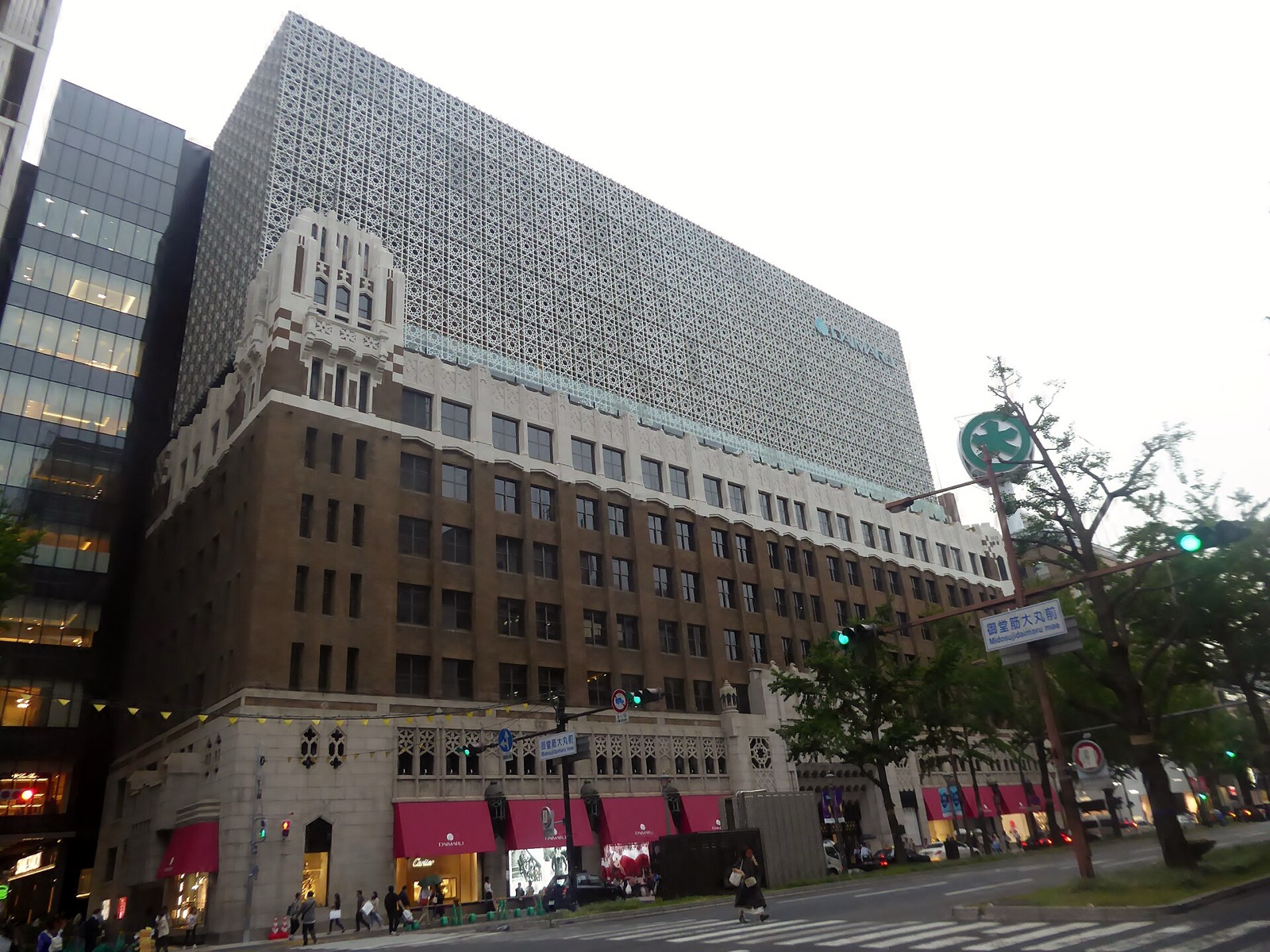

Daimaru Shinsaibashi is the anchor, and it fronts both Midosuji and the arcade. According to its operator, Daimaru opened here as a kimono shop on 1 November 1726 and has never moved, so 2026 is its 300th year. The anniversary programme runs until 26 November 2026. The main building was rebuilt and reopened in September 2019, with the original W. M. Vories facade restored. That’s what you see from the street: the ornate lower floors are the restored Vories design, and the lattice-covered block above them is new.
Daimaru’s posted hours are 10:00–20:00 for most floors, with the B2F food hall and 10F restaurants open 11:00–22:00. It closes only on 1 and 2 January. The basement food hall is the easiest good-quality lunch in the area if the arcade’s crowds are getting to you. Next door, Shinsaibashi PARCO (shops 10:00–20:00) has a B2F food alley open until 23:00.
The ginkgo and the lights. Osaka Metro says the trees turn yellow all at once in late November, but it varies from year to year. From 3 November to 31 December 2026, the Midosuji Illumination lights about 4 km of the avenue from Umeda down to Namba, from about 5pm until 1am, according to the City of Osaka’s announcement. If you’re here in the last week of November, you may get gold leaves and lights on the same evening (see our Kansai autumn leaves calendar for this year’s forecasts).
Amerikamura: vintage clothing, Triangle Park and the evening
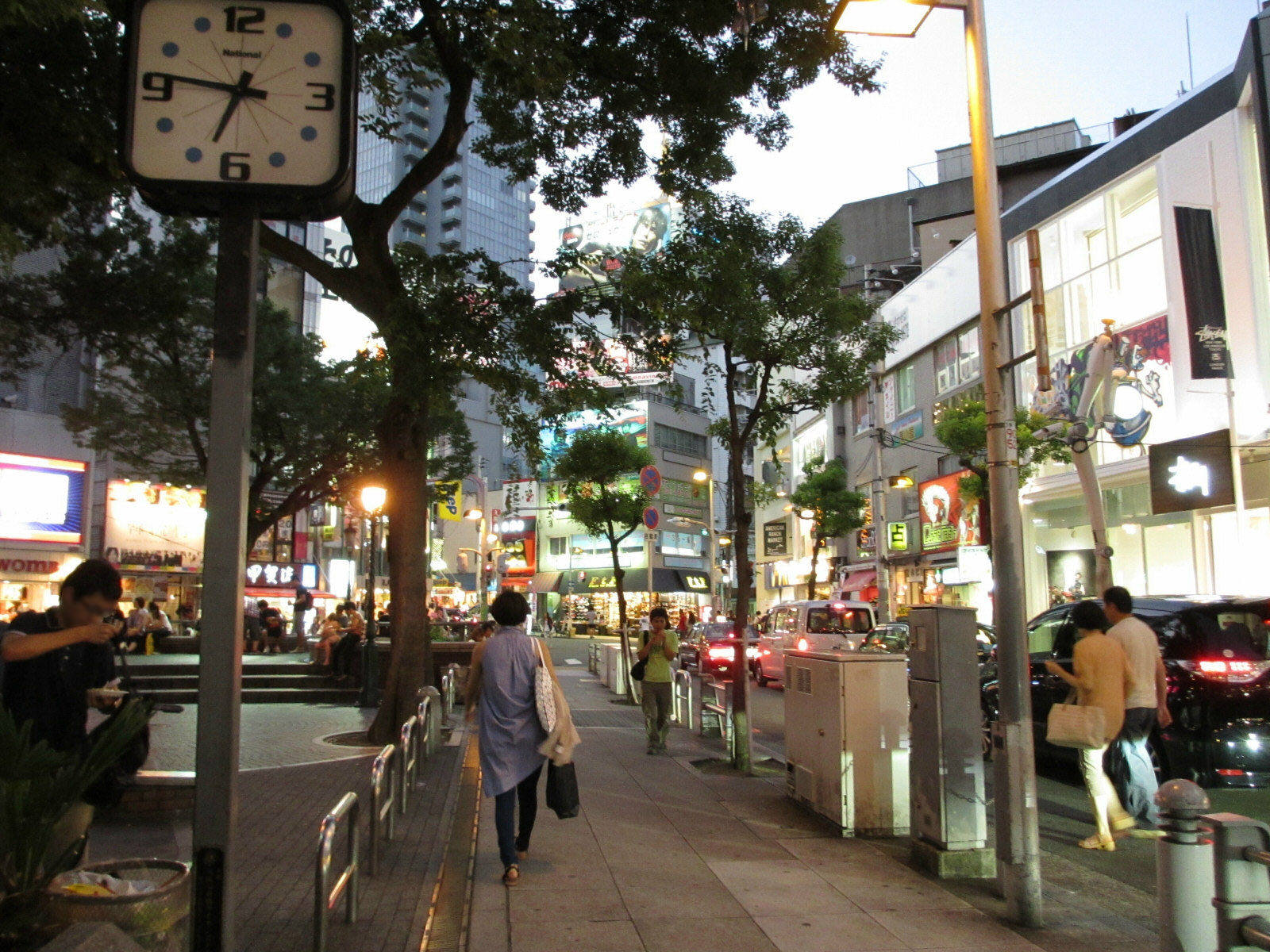
Amerikamura is worth it if you like clothes, music or people-watching, and it’s best from late afternoon. It’s the grid of streets on the west side of Midosuji. Locals call it Amemura (アメ村).
According to the shopkeepers’ association, it was a quiet area of warehouses and car parks until a café opened by Triangle Park in 1969 drew young designers. In the 1970s, shops in cheap empty warehouses started selling used records, jeans, T-shirts and vintage clothing. Imported American goods were rare and popular, and that’s where the name “America Village” comes from.

What you’ll find:
- Vintage clothing (furugi, 古着) and streetwear. This is the main reason to come. Shops range from tidy, curated boutiques to piles you dig through.
- Triangle Park (Sankaku Kōen, 三角公園). Officially it’s Mitsu Park, a small paved triangle that’s the area’s landmark and meeting point. Osaka’s tourism site notes that young comedians sometimes perform free manzai (double-act stand-up) for passers-by, and there’s a long-running takoyaki shop beside it. (For the local view on takoyaki and how to spot tourist food, see our Osaka food guide.)
- The evening. As the shops close, the small bars, live-music venues and late food take over. It’s young, loud and casual rather than polished.
Who’ll be disappointed: anyone expecting temples and wooden streets, and anyone who doesn’t care about clothes. Without the shopping, Amemura is a few busy blocks of shopfronts.
How do you combine Shinsaibashi with Namba and Dotonbori on foot?
Walk it as one north–south line, and the whole thing takes about two to three hours with browsing. The shopping street’s own English site puts the arcade a 15-minute walk from Namba Station.
A route that works in either direction:
- Namba → Ebisubashi-suji. From Namba, head into the Ebisubashi-suji arcade. According to the shopping street’s access page, it’s a roughly 370 m covered arcade running from Takashimaya up to the Dotonbori canal. From the subway, use Namba Walk exits 12–13, or exit E3 of the NAMBA nannna underground street from the Midosuji Line’s south gate.
- Ebisubashi bridge. This is the bridge over the Dotonbori canal, with the Glico running-man sign on the canal bank beside it. Dotonbori’s main food street runs off to the right (east) just before the bridge. What to eat there, and how to spot the tourist traps.
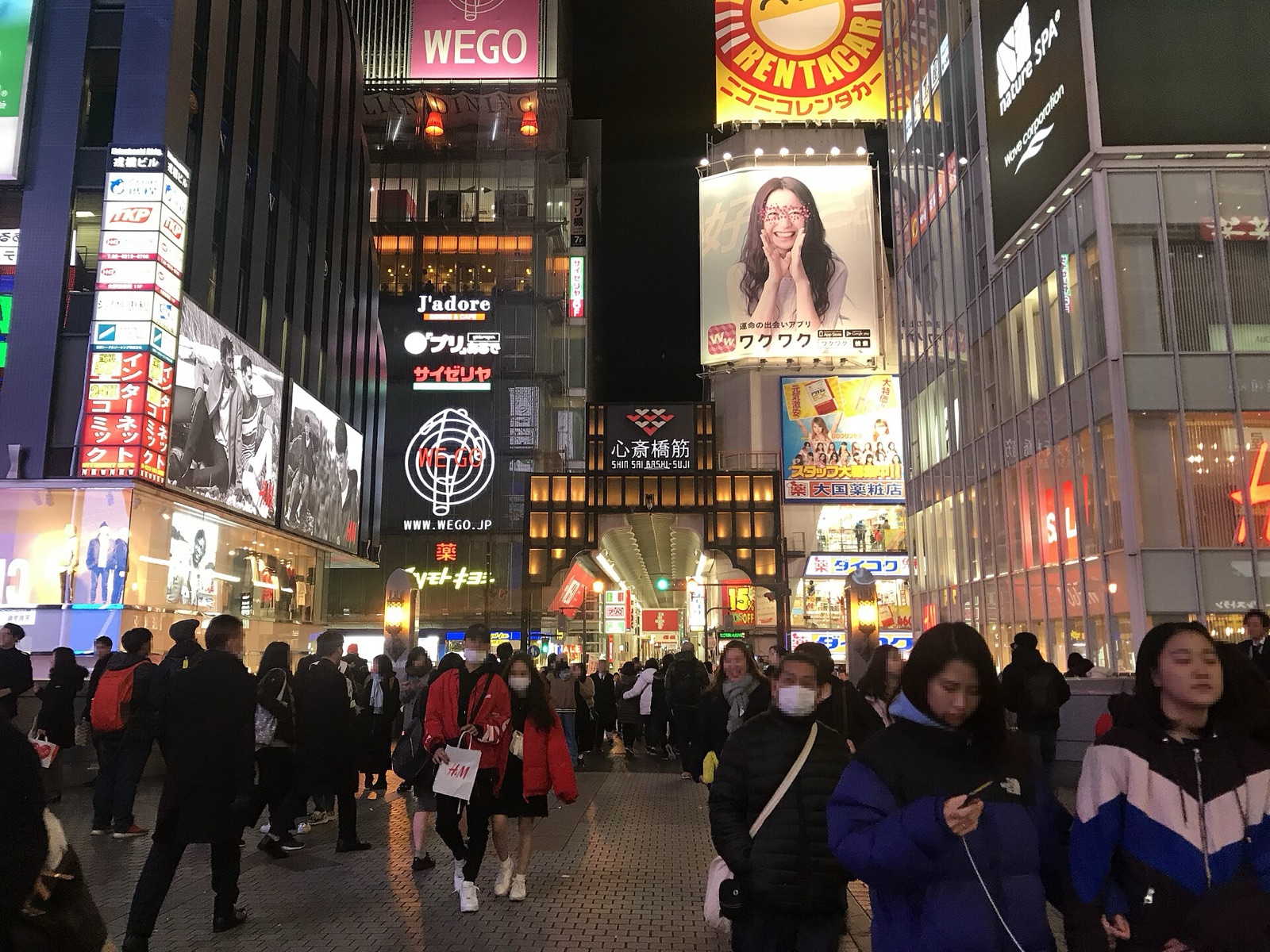
- Shinsaibashi-suji. Straight on from the bridge, the arcade’s gateway is ahead of you (it’s the first photo above). Walk up to Daimaru and PARCO in its northern section.
- Cross to Midosuji, then Amemura. Turn left (west) at any cross street onto Midosuji, then cross the avenue into Amerikamura. The association says it’s about 7 minutes’ walk from Namba subway station, so you can loop back south through Amemura and end near Namba or Dotonbori for dinner.
If you’re starting from the other end, reverse it. A good finish is Dotonbori after dark.
Which station exits should you use?
For most visitors, it’s Shinsaibashi Station on the Midosuji Line. Pick the exit by which of the three areas you’re heading for. Exit details are from Osaka Metro’s Shinsaibashi exit map.
| Going to | Use |
|---|---|
| Daimaru, Shinsaibashi PARCO, northern part of the arcade | Shinsaibashi Exit 4, or stay underground: Daimaru connects directly from the Midosuji Line’s south gate |
| The arcade itself, from the station’s east side | Shinsaibashi Exits 4, 5 or 6 (east side of Midosuji) |
| Amerikamura / Triangle Park | Shinsaibashi Exit 8 (west side of Midosuji; walk south into Amemura), or Yotsubashi Line Yotsubashi Station Exit 5, which Osaka Metro lists for Amerikamura. The shopkeepers’ association puts Amemura about 3 minutes’ walk from either station |
| Crysta Nagahori underground mall | Shinsaibashi Exit 2 |
| South end of the arcade / Dotonbori | Start at Namba and walk north through Ebisubashi-suji |
The exit that’s gone: older guides and map apps send you to Exit 7 for Amerikamura. Osaka Metro closed Exit 7 from 12 September 2026 because the building it connects to is being rebuilt. The notice gives no reopening date. Use Exit 8, the other exit on the west side of Midosuji, instead.
Namba to Shinsaibashi by subway is one stop on the Midosuji Line, at the minimum adult fare of ¥190 (child ¥100). It’s honestly only worth it in heavy rain or with tired kids.
Is there a covered route for a rainy day?
Yes, almost. Ebisubashi-suji and Shinsaibashi-suji are both covered arcades, so the walk from Namba to Daimaru is under a roof except for Ebisubashi bridge, which is open to the sky (look at the first photo). Bring an umbrella for that stretch and for road crossings.
A rainy-day plan:
- Namba Walk or NAMBA nannna (underground) → Ebisubashi-suji arcade → Ebisubashi bridge (open) → Shinsaibashi-suji arcade.
- Duck into Daimaru or PARCO at the north end. Both are fully indoors, both have food floors, and Daimaru connects to Shinsaibashi Station underground.
- Want more indoor space? Crysta Nagahori is an underground shopping street running about 730 m east–west, linking Nagahoribashi, Shinsaibashi and Yotsubashi stations.
What isn’t covered: Midosuji and Amerikamura are open streets. Save them for a dry evening.
Is Shinsaibashi a good place to stay?
Yes, for a first trip built around food, shopping and going out, as long as you’re not a light sleeper. In our Osaka where-to-stay guide we treat Shinsaibashi and Namba as one area, Minami, and that’s how it works in practice.
What works:
- Transport. The Midosuji Line from Shinsaibashi runs direct to Namba (1 stop), Umeda (3 stops) and Shin-Osaka for the Shinkansen (6 stops). Namba is your connection to Kansai Airport. (Rapi:t vs Haruka vs bus, compared.)
- Everything is walkable. Dotonbori, the arcades, Amemura and dinner are all on foot, and late food is easy to find.
- Rain-proofing. Arcades and department stores mean a wet day isn’t a lost day.
What doesn’t:
- Noise and late crowds, especially around Amemura and the Dotonbori end on Friday and Saturday nights. Ask for a high floor away from the main street.
- Weekend crowds in the arcade make even a short walk slow.
- Day trips. For Kyoto, Nara and Kobe, Umeda is more convenient. If your trip is mostly day trips, base yourself there.
The honest truth: who should skip Shinsaibashi?
The crowds are real. Osaka’s tourism bureau puts the arcade at about 60,000 people on a weekday and about 120,000 on weekends and holidays. On a Saturday afternoon you walk at the crowd’s pace, not yours. If you can, go on a weekday morning around Daimaru’s 10:00 opening, and leave the weekend for somewhere else.
A lot of it is the same chain stores. Drugstores repeat all along the arcade, and much of the fashion is the same Japanese and global chains you’ll find in Umeda, Tokyo or a big mall at home. That’s useful if you want those exact products, and dull if you came for something you can only find in Osaka. Amemura’s independent vintage shops and the department-store food halls are where Shinsaibashi feels more particular to this city.
Skip it if:
- you have one or two days in Osaka and don’t plan to shop. See Dotonbori, glance up the arcade from Ebisubashi bridge, and spend the time elsewhere;
- you’re after traditional or historic Japan. Shinsaibashi is about commerce, and Kyoto is a short train ride away;
- crowds make you miserable and you can only come at the weekend.
The common mistakes: following an old guide to the closed Exit 7; doing your big tax-free shop in early November without knowing the refund rules have changed; and filling a suitcase with drugstore buys on day one, then dragging it around for the rest of the trip.
And the bit that’s genuinely good: walking from Namba to Daimaru under cover on a wet day, past Dotonbori’s neon, with dinner sorted at either end. That’s a nice afternoon, and in late November, with Midosuji gold, it’s a very nice one.
FAQ
Is Shinsaibashi worth visiting in Osaka? Yes, if you like shopping or you’re already in Namba. It’s about a 15-minute walk north of Namba Station, most of it under a covered arcade, and one to three hours is plenty. Skip it if you don’t shop and hate crowds: the arcade gets about 120,000 people a day at weekends, roughly double the weekday figure.
What is the difference between Shinsaibashi-suji and Midosuji? Shinsaibashi-suji is a covered, pedestrian-only shopping arcade about 580 m long with around 180 shops, mostly drugstores, souvenirs and fashion. Midosuji is the 44 m-wide main avenue one block west, with Daimaru department store, big-brand stores and ginkgo trees that turn yellow in late November.
Which Shinsaibashi Station exit should I use? Exit 4 for Daimaru, Shinsaibashi PARCO and the northern part of the arcade (Daimaru also connects underground from the Midosuji Line’s south gate). For Amerikamura, Exit 7 has been closed since 12 September 2026: use Exit 8, the other exit on the west side of Midosuji, or Yotsubashi Station Exit 5, which Osaka Metro signposts for Amerikamura. Exit 2 goes into the Crysta Nagahori underground mall.
Can you walk from Namba to Shinsaibashi in the rain? Mostly under cover. Walk north through the Ebisubashi-suji arcade (about 370 m), cross the Dotonbori canal on Ebisubashi bridge, which is open to the sky, then carry on up the Shinsaibashi-suji arcade (about 580 m). If you’d rather stay completely dry, the Midosuji Line is one stop and costs ¥190.
Is Shinsaibashi a good place to stay in Osaka? It’s a good base for a first trip built around food, shopping and nightlife. The Midosuji Line runs direct to Namba (1 stop), Umeda (3 stops) and Shin-Osaka (6 stops), and Dotonbori is walkable. Light sleepers and people who want calm evenings are better off in Umeda, Honmachi or Nakanoshima.
When do the Midosuji ginkgo trees turn yellow? Usually in late November, according to Osaka Metro, though it varies year to year. In 2026 the Midosuji Illumination runs from 3 November to 31 December, lit from about 5pm to 1am along roughly 4 km of the avenue between Umeda and Namba.
Hours, exits, fares and dates checked against official sources (Osaka Metro, the City of Osaka, the Osaka Convention & Tourism Bureau, Daimaru and the shopping-street associations) in October 2026. They change, and Exit 7 may reopen, so confirm before you travel. Written by a Kansai-based team who live here.