# Karaage in Japan: What It Is, How to Order It at an Izakaya or Konbini, and the Great Lemon Debate
> Japanese fried chicken explained: the soy-garlic-ginger marinade, thigh vs breast, izakaya karaage, Famichiki and Karaage-kun at the convenience store (with current prices), buying by the 100 g at specialist shops, and whether you're allowed to squeeze the lemon.
Source: https://ninjapan.vercel.app/articles/karaage-japanese-fried-chicken-how-to-order/ (published 2026-10-02, by ninjapan — a Kansai-based team living in Osaka)
*Every izakaya menu has it, every convenience store sells it, and it comes with a lemon wedge that has started more arguments than it deserves. Here's how karaage works, from a Kansai-based team that includes people who run a restaurant in Osaka.*
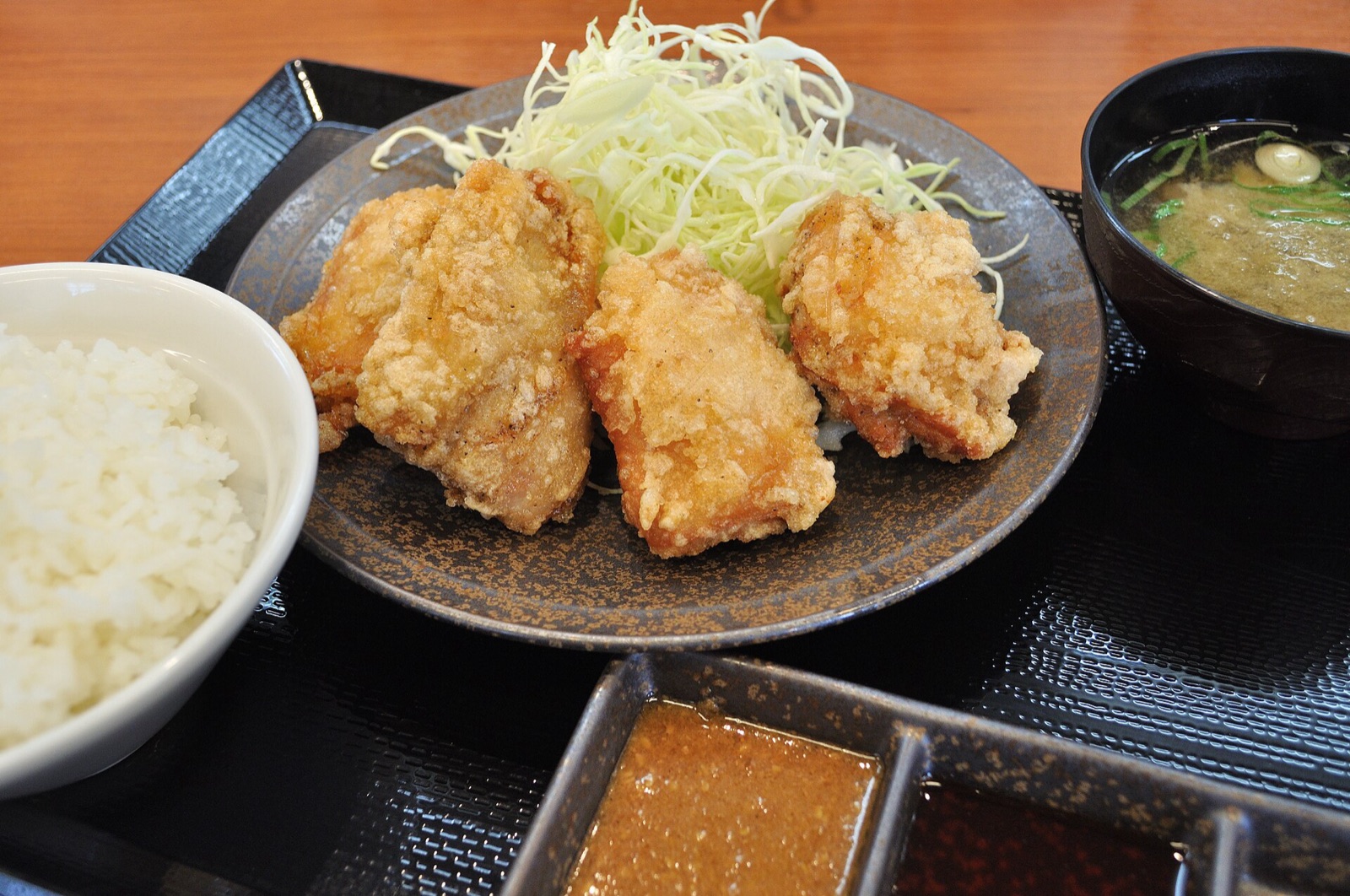
Karaage as a set meal: chicken, cabbage, rice and miso soup. At an izakaya it comes on its own, to share. Photo: Ocdp / CC0
**The 30-second answer:**
- **Karaage (唐揚げ, kah-rah-ah-geh)** is Japanese fried chicken: bite-size pieces, usually boneless, marinated in soy sauce with garlic and ginger, then coated in potato starch or flour and deep-fried. It's lighter and crunchier than Western fried chicken, and the flavour is in the meat, not the coating.
- **At an izakaya** (Japanese pub), it's a shared plate for the middle of the table. Just ask for "karaage". At Torikizoku, for example, every regular food and drink item is **¥410** including tax from 1 October 2026.
- **At convenience stores**, it lives in the hot case by the register. Current official prices: **Famichiki ¥248** (FamilyMart), **Karaage-kun ¥288** for five pieces (Lawson), **Nanachiki ¥232 before tax** (7-Eleven). Ask at the register or point.
- **At specialist takeout shops**, karaage is priced **per 100 g**. In Nakatsu, karaage's self-declared "holy land" in Oita, 100 g of boneless karaage is about three pieces at one shop in Oita Prefecture's guide, a handy rough conversion.
- **The lemon:** don't squeeze it over the shared plate without asking. It's a famous, half-joking etiquette argument in Japan, and the safe move is to ask first or squeeze it over your own piece.
- **Allergies:** all the big konbini chickens list **wheat and egg**. A starch coating doesn't make karaage gluten-free.
---
## What is karaage, and how is it different from Western fried chicken?
**Karaage is chicken that gets its flavour from a marinade, not from the coating.** Bite-size pieces are soaked in a seasoning that, in most versions, is built on soy sauce, garlic and ginger. Usa city in Oita, which takes karaage very seriously, describes its shops' marinades exactly that way, each with a secret recipe. Then the pieces are dusted in **katakuriko** (potato starch), wheat flour or a mix, and deep-fried.
What that means on the plate:
| | Karaage | Typical Western fried chicken |
|---|---|---|
| Size | Bite-size, usually boneless | Big bone-in pieces or tenders |
| Seasoning | In the meat: soy, garlic, ginger marinade | Mostly in the breading, sometimes a brine |
| Coating | Thin. Potato starch fries up crunchy and craggy, flour softer | Thick seasoned flour or batter |
| Eaten with | Beer, rice, a lemon wedge, mayo | Sides, sauces |
| Hot or cold | Both. Cold karaage is a standard lunchbox item | Mostly hot |
**Thigh or breast?** Japanese menus distinguish them: **momo (もも)** is thigh, **mune (むね)** is breast. Thigh is juicier. Breast is leaner and can be drier. The convenience-store versions split the same way. FamilyMart says Famichiki uses a part of the thigh, while Lawson says Karaage-kun was developed to make chicken breast taste good.
Other words you'll see on menus: **nankotsu karaage** (fried chicken cartilage, crunchy, a classic beer snack), **tebasaki** (wings) and **honetsuki** (bone-in).
## How do you order karaage at an izakaya?
**Just say "karaage", or "karaage hitotsu" (one karaage), and it comes as a shared plate.** At an izakaya, dishes go in the middle of the table and everyone picks with their chopsticks. Karaage is a standard early order alongside the first round of drinks, because it goes so well with beer.
On the menu, look for 唐揚げ, から揚げ or からあげ (all the same word), often as 鶏の唐揚げ (tori no karaage, chicken karaage) or 若鶏の唐揚げ (young chicken karaage). Many menus list the number of pieces, which helps you judge how many plates the table needs.
**What it costs:** it depends on the place. One chain publishes a single price for everything: [Torikizoku](https://torikizoku.co.jp/assets/uploads/2026/09/2026.09.10.pdf), the yakitori chain with the yellow signs, moved its regular food and drink items to **¥410 including tax** on 1 October 2026 (set courses are priced separately), and its menu lists its own karaage as a signature dish.
Two things to know before you sit down:
- **An unordered small dish may arrive first.** That's otoshi, a per-person charge at many izakaya. [Here's what it costs and how to ask about it](/articles/otoshi-izakaya-cover-charge-japan/).
- **It comes with lemon.** Izakaya karaage usually arrives with a wedge of lemon on the side, which brings us to the most important section of this article.
## The great lemon debate: can you squeeze it over everyone's karaage?
**Not without asking.** In Japan, whether to squeeze the lemon over a shared plate of karaage is a famous, half-serious etiquette argument. It turns up again and again on TV variety shows and social media, and it splits tables.
**Team lemon** says that's what the wedge is for: the acid cuts the grease. **Team no-lemon** says it makes the crisp coating soggy, and once it's done, it can't be undone. Both sides are right, which is why the argument never ends.
The real offence isn't the lemon. It's squeezing it over **everyone's** karaage without asking. Some actual numbers:
- In a [2020 survey by House Foods](https://comeon-house.jp/opendata/sp/index.html) of 13,617 members of its customer website, **66.2%** said they put lemon on karaage and **33.8%** said they don't. **Among the lemon users, 96.2% said they check with the people around them before squeezing.** (Note that three-quarters of the respondents were women, so this isn't a perfect cross-section of Japan.)
- A 2024 poll by the weather service Weathernews got 13,138 responses and found the two camps **almost evenly split**.
So somewhere between a third and a half of the table may not want lemon. And in the House Foods survey, nearly everyone who does want it says they ask first. That's the etiquette.
**The safe moves, in order of politeness:**
1. **Ask first:** *"Remon kakete mo ii desu ka?"* (レモンかけてもいいですか?, "Is it OK if I put lemon on?"). Asking is the move that wins you points.
2. **Squeeze it on your own piece only.** Take a piece onto your small plate, then squeeze. Nobody can object.
What not to do: grab the wedge as the plate lands and squeeze it over everything, however helpful it feels. Nobody will make a scene, but someone at the table may quietly mourn their crunchy coating.
## How do you buy fried chicken at a Japanese convenience store?
**Ask for it by name at the register, or point at the label.** The chicken sits in a heated glass case next to the counter, not on the shelves. Queue with the rest of your shopping and say *"Famichiki hitotsu kudasai"* ("One Famichiki, please"). Staff pick it out with tongs and hand it over in a paper sleeve or box.
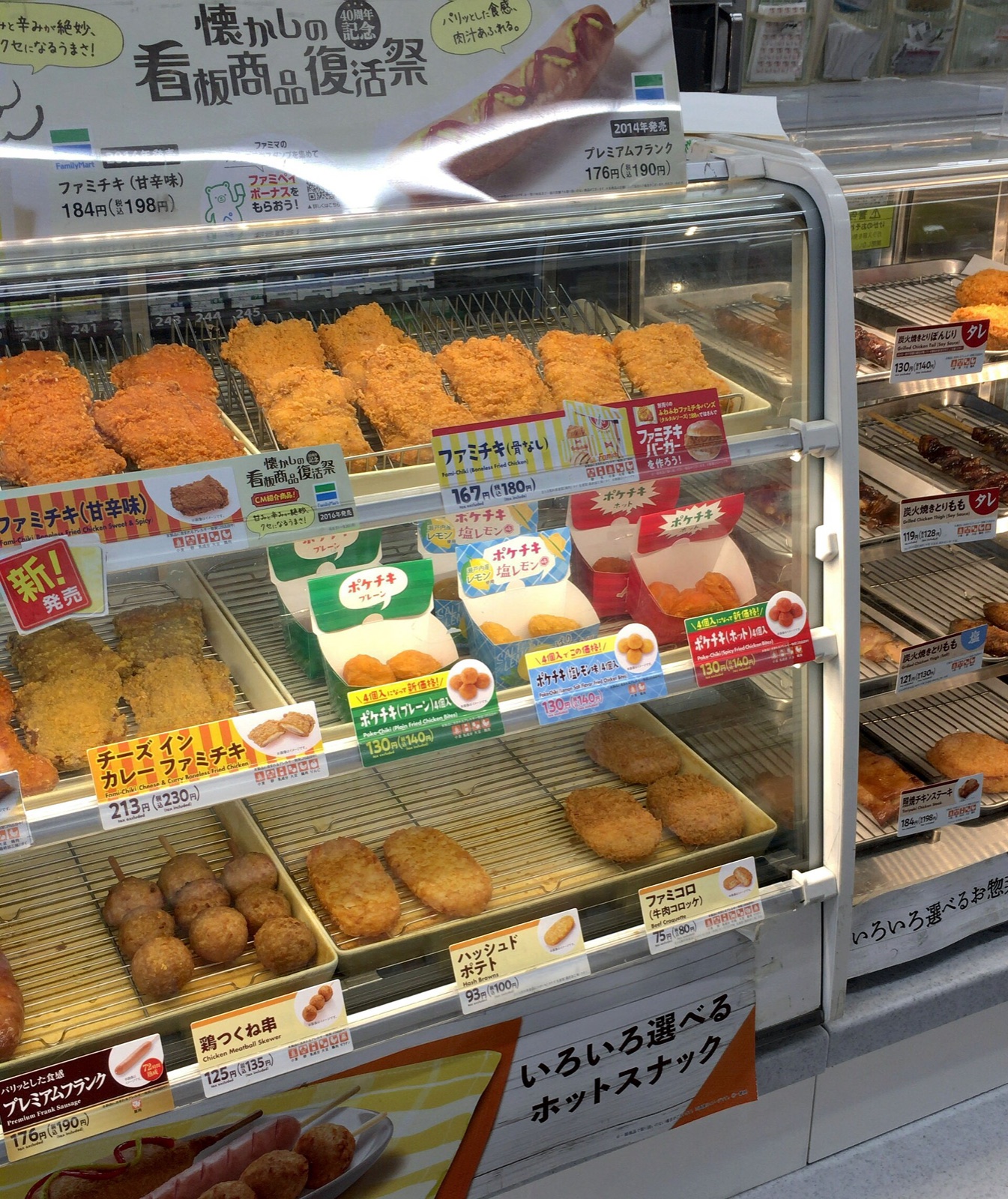
The hot case at a FamilyMart in 2021. The labels give English names and the price with and without tax. The prices in this photo are out of date: Famichiki is ¥248 now. Photo: 毒島みるく / CC0
The big three chains' chicken, with prices from their official product pages in October 2026:
| Chain | Item | What it is | Price |
|---|---|---|---|
| FamilyMart | [Famichiki](https://www.family.co.jp/goods/friedfoods/0253116.html) (ファミチキ) | One boneless fried chicken piece, thigh meat, crisp coating | ¥248 incl. tax (¥230 before tax) |
| Lawson | [Karaage-kun Regular](https://www.lawson.co.jp/recommend/original/detail/1390563_1996.html) (からあげクン) | Box of 5 bite-size karaage pieces, breast meat. Sold since 1986 | ¥288 incl. tax |
| Lawson | L-Chiki Regular (Lチキ) | Fried chicken | ¥248 incl. tax |
| 7-Eleven | [Nanachiki](https://www.sej.co.jp/products/a/cat/090030010000000/) (ななチキ) | Thick, juicy fried chicken with a light crisp coating | ¥232 before tax (listed as ¥250.56 with tax) |
| 7-Eleven | Agedori (揚げ鶏) | Fried chicken with a simple Japanese-style salt seasoning | ¥232 before tax (¥250.56 with tax) |
| 7-Eleven | Karaage-bō (からあげ棒) | Karaage pieces on a skewer, listed for the **Kinki (Kansai) region** | ¥184 before tax (¥198.72 with tax) |
Strictly speaking, of the items in this table only Karaage-kun and the Karaage-bō are sold as karaage. Famichiki, Nanachiki and L-Chiki are sold as "fried chicken". Karaage-kun also comes in rotating flavours (Red, the spicy one, is a regular), at ¥288–¥298 in October 2026.
**Three things that catch visitors out:**
- **Eating in costs more.** Takeaway food is taxed at 8% and food eaten on the premises at 10%, under National Tax Agency rules. The prices above are takeaway prices. If you're going to eat at the store's counter seats, tell the staff at the register. Stores generally assume takeaway unless you say otherwise. (The government has also proposed cutting the tax on takeaway food to 1% for two years from April 2027. That still needs a law passed, so check nearer the time.)
- **Not every store carries every item.** All three chains say so on their product pages. Lawson notes that Karaage-kun isn't sold at its Natural Lawson stores.
- **Chicken sales happen.** FamilyMart and 7-Eleven both run chicken sales from time to time, such as money off when you buy two. Look for a banner on the hot case.
Want the wider picture on why konbini are a highlight, not a fallback? [It's number 16 here](/articles/17-things-that-confuse-first-timers/).
## How do specialist karaage shops work, and how do you read a per-100 g price?
**Many specialist shops (karaage senmonten, からあげ専門店) sell karaage by weight, so the price on the board is per 100 g.** You'll see something like 「もも 100g ○○円」: thigh, so many yen per 100 g. In a guide to Nakatsu shops on Oita Prefecture's site, one shop's 100 g of boneless karaage comes to **about three pieces** (wings: about two). Piece size varies by shop, but that's a useful rough conversion to keep in your head.
How to order:
1. **Pick the cut:** momo (thigh), mune (breast), or a mix if they offer one. Many shops also do tebasaki (wings), sunagimo or zuri (gizzard) and bone-in pieces.
2. **Say the weight:** *"Momo, nihyaku guramu kudasai"* ("200 g of thigh, please"). 200 g is roughly six boneless pieces, enough for one hungry person or two as a snack.
3. **Wait.** Many shops fry after you order. Nakatsu's tourism association lists it as a defining feature of the local style.
**About the "Gold Award" banners.** Many shops display a からあげグランプリ 金賞 (Karaage Grand Prix Gold Award) sign. The Grand Prix, run by the Japan Karaage Association, is split into categories by region and flavour style. Its published results show the 17th edition gave a top or gold award to **61 shops** in the general division (out of 397 entries), plus more in its lunchbox and supermarket divisions. A gold banner means the shop won something, not that it's the best on the street.
## Why is Nakatsu (Oita) called the karaage capital?
**Because it built its identity on it.** Nakatsu, in northern Oita Prefecture in Kyushu, is promoted by the [Nakatsu-Yabakei Tourism Association](https://nakatsuyaba.com/pages/434/) as **the "holy land" (聖地, seichi) of karaage**. The association even claims the town has more karaage shops than schools or convenience stores. The local karaage association says the town has **40-something specialist shops**. The local style, according to the tourism association, is chicken marinated in a salt-and-soy-based house sauce and fried to order.
Next door, [Usa city](https://www.city.usa.oita.jp/tourist/gourmet/gourmet/10017.html) calls itself **the birthplace of karaage specialist shops**. According to the city, a Chinese restaurant called Rairaiken started frying cheap chicken from local poultry farms after the war, an izakaya learned the method and turned into a karaage-only shop, and the style spread from there to Nakatsu.
It's a Kyushu detour, not a day trip from Osaka.
## What do you put on karaage?
**Lemon, Japanese mayonnaise, or nothing at all.** The usual options:
- **Lemon:** the default garnish. Read the etiquette section above before you touch it.
- **Mayonnaise:** Japanese mayo is richer and tangier than most Western mayo, and a blob on the side of the plate is very normal.
- **Shichimi tōgarashi (七味唐辛子):** seven-spice chilli pepper. Often shaken over the mayo to make a quick spicy dip.
- **Nothing:** a well-marinated karaage doesn't need anything. Try the first piece plain.
- **On menus:** grated daikon radish with ponzu (citrus soy) is a common variation.
If karaage is your gateway, Osaka's other fried classic is kushikatsu, which has its own sauce rule. [Here's how that one works](/articles/osaka-what-to-eat/).
## The honest truth about karaage
**Konbini chicken is best fresh, and you can't always tell when it was fried.** Hot-case items are cooked in batches and kept warm. At the lunch and evening rushes the trays turn over fast. Mid-afternoon or late at night, your chicken may have been sitting a while. Still decent, but a fresh one is a different food.
**Things sell out.** At peak times trays empty, and you may have to wait for the next batch or choose something else. Specialist shops can also close early when they run out.
**Allergies: assume wheat and egg.** Famichiki, Karaage-kun and 7-Eleven's Nanachiki all list **wheat and egg** on their official allergen tables, and Famichiki and Nanachiki also list milk and soy. A potato-starch coating doesn't make karaage gluten-free, because the marinade is usually soy sauce, which is normally brewed with wheat. Lawson also notes that its products may share production or cooking processes with other allergens. If you have a serious allergy, show staff a written card. Our [otoshi guide](/articles/otoshi-izakaya-cover-charge-japan/) links the government's free English allergy card.
**Who should skip it:** if what you want is a big bone-in piece of Southern-style fried chicken, karaage won't scratch that itch. It's a smaller, saltier, more garlicky thing.
**The common mistake:** queueing at a famous-name shop when the izakaya you're already in makes a perfectly good plate. Karaage is everyday food here. The best plate is often the one in front of you, with beer, as long as you ask before you squeeze.
---
## FAQ
**What is karaage in Japan?**
Karaage (唐揚げ) is Japanese fried chicken: bite-size pieces, usually boneless thigh or breast, marinated in soy sauce with garlic and ginger, coated in potato starch or wheat flour and deep-fried. It's served with a lemon wedge at izakaya, sold hot at convenience stores and sold by weight at specialist shops.
**How much do Famichiki and Karaage-kun cost?**
On the chains' official pages in October 2026, FamilyMart's Famichiki is ¥248 including tax and Lawson's Karaage-kun Regular (a box of five pieces) is ¥288. 7-Eleven's Nanachiki and Agedori are ¥232 before tax (listed as ¥250.56 with tax). These are takeaway prices; eating in the store is taxed at 10% instead of 8%.
**How do I buy fried chicken at a Japanese convenience store?**
The chicken sits in a heated glass case next to the register. Queue at the register and ask for it by name or point at the label, for example "Famichiki hitotsu kudasai" (one Famichiki, please). Tell the staff if you'll eat it in the store's seating area, because eat-in is taxed differently.
**Is it rude to squeeze lemon on karaage in Japan?**
It can be, on a shared plate. Squeezing lemon over everyone's karaage without asking is a famous, half-joking etiquette debate in Japan. The safe move is to ask "Remon kakete mo ii desu ka?" (Is it OK if I put lemon on?) or squeeze it over your own piece only.
**Is karaage gluten-free?**
Don't assume so. Even when the coating is potato starch, the marinade is usually soy sauce, which is normally brewed with wheat. Famichiki, Karaage-kun and 7-Eleven's Nanachiki all list wheat and egg among their allergens.
**Where is the karaage capital of Japan?**
Nakatsu in northern Oita Prefecture, Kyushu, which its tourism association calls the "holy land" of karaage. Neighbouring Usa city calls itself the birthplace of karaage specialist shops. Many shops there price karaage per 100 g.
---
*Prices, product names and survey figures checked against official sources in October 2026. Konbini prices and flavours change often, so check the label on the hot case. Written by a Kansai-based team that includes people who run a restaurant in Osaka.*